
Introduction
Modern leadership in organisation is rapidly evolving, shifting away from traditional autocratic authority toward collaborative, agile, and purpose-driven practices. Organisational leadership has been in the limelight due to specific approaches, styles, and traits. Industry dynamics and new expectations have led to significant changes in leadership practices. It seems imperative to see to what extent the leadership has changed in recent years. The most important thing is to assess the reason behind these changes and set the foundation for valuable implications and takeaways. These leadership changes are meaningful for me as a leader, as far as my personal development is concerned. This thorough study revolves around the detailed evaluation of these leadership changes, which can further help to develop leadership skills. There are some experiences and organisational environments that I need to become an effective and better leader. The study explores these possibilities and opportunities in the context of the recent leadership change.
Extent Leadership Changed in Recent Years
Leadership has changed in recent years, especially in the evolving business landscape. The role of technology and new social expectations also created a significant impact on this transformation. This analysis will provide a blend of theory and practical implications to explore the possible leadership changes. The detailed illustration is as follows.
Networked Leadership is a New Trend
Leadership has changed, as it contains modern perspectives. Conventionally, the leadership process has been perceived as an individual leader who can lead people and organisations. There were visionary founders, charismatic leaders, and authoritative managers in the organisation. In the modern business landscape or organisational setting, these models or themes need to be revised as far as the complicated challenges are concerned. For instance, it has been unveiled that the leadership emerges as a network of leadership teams. Individual members of the leadership team have leadership capabilities and skills (Smet et al., 2023). These leaders coordinate, navigate the organisation, and set the foundation for good results. Interestingly, there are high-performing leadership groups that streamline individual expertise and capabilities. Thus, it indicates that leadership is not centred on a single individual in the organisation, as networking has made it more dynamic and progressive. For example, I was part of the small tech startup of one of my family members. I experienced a dynamic leadership team instead of an authoritative leader (CEO). This small startup formed a leadership team that contained finance, marketing, technology, and operational expertise. There was an incredible collaboration among team leaders to set a new strategic direction for the organisation. It was all about leveraging the varying perspectives and evading possible uncertainties in the business climate (Smet et al., 2023).
Accepting Complications and Concentrating on Followers
Leadership has been simple and mechanical for many years. Again, it depicts the traditional approach to leadership. The recent era needs to accept or absorb the top-down approach of leadership in the organisation. Considering the aspirations and needs of followers or employees in the internal setting is a new approach. For instance, instead of just containing the top-down approach, modern leadership intends to provide coaching and empower everyone to become a better contributor (Riggio, 2020). I worked in a local call centre, where I became a team leader. Based on my learning, I realized that micromanaging is not the only solution for work effectiveness and efficiency. Accordingly, I started practising delegation, as giving autonomy was the right approach to motivate and empower employees. Ensuring autonomy, collaboration, communication, and active listening are good traits of modern leaders to enhance the visibility of productivity and creativity (Riggio, 2020).
Becoming People Oriented and Collaborative
Conventionally, autocratic leadership has been considered a vital way to manage the workforce and ensure expected business outcomes. However, this leadership concept is vanishing over time due to its irrelevance in the contemporary business era. The combination of inclusivity, collaboration, and teamwork has been in the spotlight. A prominent example of this argument is remote work, where leaders must trust the team members instead of remaining autocratic (Harman and Stein, 2014). I have navigated the examples of the organisations that had global teams. Leaders in these organisations always facilitate cross-cultural exchanges and ensure flexible work practices. The ultimate objective is to improve the collective intelligence of the whole group. It is one of the critical learning takeaways for me as a future leader, as managing teams in the global business climate needs a people-oriented approach (Marsh, 2022).
Leadership is Purpose Driven
One of the most significant and positive changes in leadership is that leaders do not just concentrate on the shareholder’s profitability. Meeting the economic responsibility of the business is a fundamental aspect, but it is not the only factor. The new leadership paradigm shows inclusion and sustainability along with the connection with profitability. It indicates purpose-driven leadership in the organisational setting, as aligning with societal expectations and needs has become a new assumption (Demirtas, 2013). The most important thing is creating value for all key stakeholders instead of just focusing on shareholders. I worked as a volunteer in a community service entity at the local level. It was a good experience because I observed some initiatives by the company leadership to provide benefits to employees, clients, and the community. I have learned that a purpose-driven approach must be embedded in the decision-making process (Lewis, 2021).
Adaptation and Agility
Agility has become one of the fundamental aspects or attributes of the new leadership. It justifies the significant change in recent years. For instance, companies can face challenges in the form of uncertainties and trends. Swift adoption has become mandatory for leaders to become more change oriented. Continuous learning and effective change management practices are new leadership traits that can help the organisation remain relevant and competitive. I have observed many sales managers or leaders who adopted new sales tactics due to the changing customer trends and preferences. I learned that agility and adaptation are the best sources for leadership and organisational survival (Petermann and Zacher, 2020).
Transformational Leadership in the Digital Era
Transformational leadership has been in the spotlight, as it is a leadership process of inspiring and motivating followers to help them reach their full potential. However, this trend is changing, as these transformational leaders have used technologies to encourage innovation and enhance the visibility of collaboration. For example, as a manager in an organisation, I would like to use advanced communication technology to engage my employees or followers. It is all about enhancing productivity and communication through technology to meet innovative and motivational objectives (Afsar and Umrani, 2020).

Dimensions of transformational leadership
(Sunaengsih et al., 2021)
Adaptive Leadership
The leadership has become adaptive, primarily in the VUCA era. The organisation can stumble in uncertain, volatile, complex, and vague situations in both internal and external business climates. Comparatively, the nature of business has become unpredictable. Today, leaders are willing to adopt change by steering uncertainties. In the organisation, I can emerge as a leader or manager. Getting out of a demanding or uncertain situation may require some improvisation from a leader, and I am looking to embrace this change (Ahmad et al., 2022). The most important thing is to thrive in ambiguity and set the foundation for a continuous learning culture in the organisation.
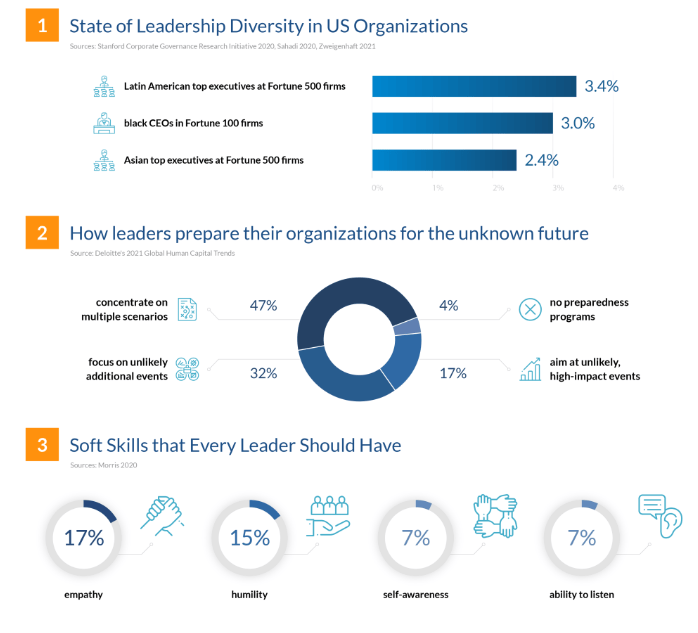
Recent Leadership Adaptations
(Financesonline.com, 2024)
Leadership and Inclusivity
Eventually, the leadership will change due to inclusivity needs. The most important thing is to value and leverage diversity in the organisation to set the ground for creativity and the overall success of the organisation. In the modern workplace era, diversity, inclusion, and equity are essential facets. Progressively reaching out to diverse viewpoints has become a new norm. I prefer a diverse team in the organisation as a manager or a leader to make the team more creative and innovative. Apart from that, diversity and inclusion are good sources to justify social responsibility. Today’s leadership is free from any bias or discrimination, and diversity and inclusion are the best ways to move forward (Yang, 2018).
Ethical Leadership
Eventually, leadership has become ethical. Ethical leadership is an appropriate theory that stresses the decision-making process based on fairness, integrity, and justice. In today’s world, followers and other stakeholders expect transparency in communication and decision-making, and leaders are aware of it. Modern leaders are coming up with ethical values and standards to win the trust of stakeholders. It is a significant change in leadership, as I must strive for ethical conduct as a leader in the organisation (Demirtas, 2013).
Meanings of Changes and Personal Leadership Development
These leadership changes are meaningful for me and my personal leadership development. The above analysis has helped me to derive valuable insights and implications. The detailed illustration of this reflection is as follows.
Collaboration and Consistent Learning
For instance, collaborative leadership is a new trend in the organisation. I have realized the significance of collaboration in the leadership function. I will not depend on individual strength, as I would like to integrate with diverse viewpoints and shape collaborative groups. The most important thing is to shape the network of mentors, team members, and peers who have different skills and expertise (Harman and Stein, 2014). The combination of adaptability and consistent learning is also apparent. I will develop myself as a leader by understanding the need for ongoing education. I will come up with a growth mindset. Indeed, it will be possible by becoming open to new ideas, work patterns, and technologies. Based on this knowledge and realization, I will invest time in education, align with industry trends, and become agile in demanding or uncertain situations (Bolea and Atwater, 2014).
Shift in Leadership Approach
Focusing on followers is also a significant change in leadership. It is meaningful because my perception of leadership has changed. Of course, when developing myself as a leader in the organisation, I will not have an autocratic or authoritative approach. These theories have become outdated as far as the new expectations and needs of the modern workplace are concerned. I will become an active listener to understand the perspectives, needs, and reservations of followers. The leader must be a mentor in different ways to meet the needs of followers and help them reach their full potential. I must have the capability to delegate to foster innovation and autonomy. Leadership development also interrelates with relationship building, and fostering strong relationships is integral for me as a leader (Afsar and Umrani, 2020).
Purpose Driven Leadership
Purpose-driven leadership has been identified as a significant change in leadership. It is valuable and meaningful for me because I understand the importance of aligning my values in the leadership process. I will consider the influence of my decisions on long-term goals and business sustain agility instead of just concentrating on short-run objectives. For example, I am aware of social responsibility and its importance in the corporate setting. Thus, my values must align with societal well-being, especially when making decisions as a leader. I will set new personal leadership objectives and show commitment to ethical values (Brennan, 2014).
Complications and Simplicity
Creating a good balance between complications and simplicity is also important in modern leadership. I need to be more straightforward in the dynamic business and organisational setting. I should be capable of analysing the complications. The critical assumption is that communication and strategies must be precise. The most important thing is making the teams or followers comprehend the overarching objectives. Conveying complicated ideas can be challenging for a leader. However, I can prepare myself to streamline these complexities. It will justify effective leadership development, as a leader must be prepared and effective in complex situations (Ryan, 2009).
Innovation, Agility, and Well Being
The combination of innovation and agility is also one of the best takeaways from the described leadership changes. I have learned that fostering an innovative mindset is the only way to become relevant as a leader in the organisation. I will develop myself as a leader by becoming capable of experimentation. The leadership development must include risk evaluation and mitigation approaches. In a dynamically changing business situation, the leader must be able to assess risks in terms of impact, responsibility, probability, and possible strategies. Finally, leadership changes made me realize that I need to invest in my well-being. I will foster the work-life balance, invest in myself, and extend it to support my team. The leadership development process can help me understand the importance of well-being, and I can apply it to team members to create a positive work climate (Day, Harrison and Halpin, 2008).
Developing your Leadership Skills: Experiences and Organisational Environment
Developing leadership skills and becoming a better leader are good considerations. The detailed illustration regarding these considerations is as follows.
Formal Education and Training
I can further develop leadership skills by getting formal education and training. I will complete the leadership courses. Attend workshops and get adequate certificates. It is all about gaining a deep understanding of the theoretical frameworks or models. Apart from this, this formal education also includes valuable case studies, which can help (Marques and Dhiman, 2016)adopt new skills. I want to emerge in an organisational environment where the culture of ongoing learning is apparent. I want to find companies or employers that intend to invest in staff development. The organisation providing leadership training is an ideal place for me.
Coaches and Mentors
It is necessary to develop leadership skills by connecting with experienced coaches and mentors. These coaches and mentors will provide guidelines and share their experiences. For instance, mentors can provide valuable feedback, which can indicate strengths and weaknesses. Based on this feedback, skill acquisition or adaptation becomes obvious. It is all about enhancing the learning by using the mentor’s experiences (Michalski and Vilotic, 2012). Modern organisations have strived for effective mentorship for young employees. The culture of knowledge sharing is critical in contemporary organisations, and it is the best climate for me to develop as a leader. In this organisational setting, I can work with leaders who are willing to train team members.
Hands-on Leadership
Hands-on leadership has become one of the fundamental aspects of the skill development process. Io can accept leadership roles that can enhance their leadership abilities. For instance, I can accept tasks that require team management, decision-making, and strategic planning (Marques and Dhiman, 2016). The organisation that provides opportunities for people to become leaders and take on high-level responsibilities is an ideal place for me. I believe that this organisational environment can boost my experiential learning in multiple ways.
Getting Constructive Feedback
Getting constructive feedback from peers is also the right approach to developing skills. It can lead to progressive self-reflection to recognize weaknesses and strengths. This feedback will help me to identify the areas for improvement. The organisation with the feedback culture is an ideal place for me, especially when emerging as a leader (McCauley and McCall, 2014). I want to evolve in an organisational climate where effective mechanisms for performance assessment are apparent. In this environment, open communication is always crucial, and it further enhances personal development as far as skill acquisition is concerned.
Experience from Different Departments
Gaining experience from different departments in the organisation is also one of the effective ways to develop myself as a leader. Skill development will become evident if I understand the business dynamics. Of course, I can shape the holistic viewpoint about leadership through this understanding (McCauley and McCall, 2014). An organisation that provides opportunities for cross-functional work opportunities is a favourable environment. These cross-functional activities can help me to explore multiple roles, and the impact on skill development is positive.
Crisis Management
Skill development can be accelerated by participating in the crisis. Decision-making and problem-solving skills are conventional, but the leader must know how to apply these skills in demanding situations. I will seek opportunities to handle crises or demanding conditions in the best interest of the organisation. It is all about becoming capable of making effective decisions in pressure situations. It is the best leadership skill that can justify effective leadership in the organisational setting (Bhaduri, 2019). The organisation can encourage leaders to make decisions in challenging conditions. Autonomy, especially in terms of decision-making and problem-solving, is critical. The organisation that fosters autonomy is the best place for me to learn how to get out of tricky situations.
Conclusion
It concludes that the importance of leadership is evident in the organisational or business setting. Understanding leadership changes with valuable implications and insights is the best approach to open ways for skill development and leadership development. This detailed analysis emphasized the leadership changes in recent years. These changes have created a positive impact on me as a potential leader. I can develop myself as an effective leader by steering these changes. This analysis also provides insights regarding possible skill development as a leader in the organisational setting. Approaches to skill development are apparent, but there is a need to evolve in a favourable organisational setting. These skills and development initiatives should not be certain, as I need to be adaptive and resilient to keep moving as an effective leader.
References
Afsar, B. and Umrani, W.A., 2020. Transformational leadership and innovative work behavior: The role of motivation to learn, task complexity and innovation climate. European Journal of Innovation Management, 23(3), pp.402-28.
Ahmad, M.K., Abdulhamid, A.B., Wahab, S.A. and Nazir, M.U., 2022. Impact of the project manager’s transformational leadership, influenced by mediation of self-leadership and moderation of empowerment, on project success. International Journal of Managing Projects in Business, 15(5), pp.842-64.
Bhaduri, R.M., 2019. Leveraging culture and leadership in crisis management. European Journal of Training and Development, 43(5/6), pp.554-69.
Bolea, A. and Atwater, L., 2014. Applied Leadership Development: From Conceptual to Personal: Nine Elements of Leadership Mastery. Routledge.
Brennan, M.A., 2014. Community Leadership Development: A Compendium of Theory, Research, and Application. Routledge.
Day, D.V., Harrison, M.M. and Halpin, S.M., 2008. An Integrative Approach to Leader Development: Connecting Adult Development, Identity, and Expertise. Routledge.
Demirtas, O., 2013. Ethical Leadership Influence at Organizations: Evidence from the Field. Journal of Business Ethics, 126(2), pp.273–84.
Financesonline.com, 2024. 54 Key Leadership Statistics in 2024: Traits, Diversity & COVID-19 Impact. [Online] Available at: https://financesonline.com/leadership-statistics/ [Accessed 22 February 2024].
Harman, B. and Stein, S., 2014. The Art and Skill of Collaborative Leadership. Association for Talent Development.
Lewis, A., 2021. Agile Learners: The Foundation for an Organization That Thrives. [Online] Available at: https://www.harvardbusiness.org/agile-learners-the-foundation-for-an-organization-that-thrives/ [Accessed 22 February 2024].
Marques, J. and Dhiman, S., 2016. Leadership Today: Practices for Personal and Professional Performance. Springer.
Marsh, E., 2022. How leadership has changed: 2000 versus 2020. [Online] Available at: https://www.t-three.com/thinking-space/blog/leadership-2000-2020 [Accessed 22 February 2024].
McCauley, C.D. and McCall, M.W., 2014. Using Experience to Develop Leadership Talent: How Organizations Leverage On-the-Job Development. John Wiley & Sons.
Michalski, A. and Vilotic, I., 2012. Contrasting Leader and Leadership Development – Implications for Human Resource Management. GRIN Verlag.
Petermann, M.K.H. & Zacher, H., 2020. Agility in the workplace: Conceptual analysis, contributing factors, and practical examples. Industrial and Organizational Psychology, 13(4), pp.599 – 609.
Riggio, R.E., 2020. Leadership 101: How Leadership Has Changed in the Last Generation. [Online] Available at: https://www.psychologytoday.com/us/blog/cutting-edge-leadership/201003/leadership-101-how-leadership-has-changed-in-the-last [Accessed 22 February 2024].
Ryan, R., 2009. Leadership Development. Routledge.
Smet, A.D., Gast, A., Lavoie, J. and Lurie, M., 2023. New leadership for a new era of thriving organizations. [Online] Available at: https://www.mckinsey.com/capabilities/people-and-organizational-performance/our-insights/new-leadership-for-a-new-era-of-thriving-organizations [Accessed 22 February 2024].
Sunaengsih, C., Komariah, A., Kurniady, D.A. and Suharto, N., 2021. Transformational Leadership Survey. Mimbar Sekolah Dasa, 8(1), pp.41-54.
Yang, W., 2018. Research on the Application Model of Adaptive Leadership in Library. Journal of Library and Information Sciences in Agriculture, 30(11), pp.162-66.