
Introduction
Issue Definition
Employee retention has been one of the significant challenges in the hospitality industry. Poor or outdated training and development programs have become the major causes of this potential issue. The outcome has been unfavorable for employees, the organization, and customers as far as customer service is concerned. The brief assessment of the studies related to the issue and the hospitality industry unveiled the excessive gap in developmental and training initiatives. Hence, the employee turnover has increased.
Studies Reviewed
There is an interrelation between employee training & development and retention. Studies have indicated that the probability of employee turnover is high in the hospitality industry due to deficiencies in the training and development function. Lack of structured or systematic training has created hurdles in personal growth, motivation, and job satisfaction.
Deficiencies in the Problem
The impact on the customers in the hospitality industry is also unfavorable. Customer service in the hospitality industry requires excellent measures to enhance the visibility of satisfaction and improved experience. Lack of retention or higher turnover has led to inexperienced staff maintaining the customer service domain. This compromise on service quality is devastating for companies, leading to customer dissatisfaction and conversion.
Paper Significance and Stakeholders
Multiple stakeholders, such as policymakers, businesses, professionals, and customers, are also in the limelight. The impact on hospitality professionals is unfavorable, as limited career growth is leading to job dissatisfaction. High turnover leads to a substantial cost or financial burden for the businesses. Policymakers are intervening in the form of regulations or policies. The impact of these policies on the standards of the service is also apparent.
Purpose
The purpose of this comprehensive study is to understand the challenge of lack of retention due to lack of training and development in the hospitality industry. The most important thing is to navigate multiple research papers (literature) and stress the need for training efforts. The goal is to obtain several insights and implications, which can further facilitate implementing effective strategies to improve retention. Retention can be the best driver to enhance performance and the image of the organization.
Literature Review
Introduction
The modern hospitality industry has stumbled due to employee retention issues. Increasing employee turnover has been in the spotlight in the organization. Lack of adequate and progressive training and development are the main reasons behind this issue. It is essential to navigate the current literature to understand the interplay of employee retention and training in the hospitality industry. There is a need to explore the multiple facets of this problem, such as deficiencies. Unearthing the insights regarding the challenge is the right approach, but there is also a need to streamline new paths for a better transition. These studies can become the source of collective knowledge, which can set the foundation for improved training strategies. Making the hospitality industry, especially in the context of the internal climate, thriving and resilient is an ultimate objective.
Overview
The adequate overview of the supporting literature indicated the importance of training and development to evade the retention problem. Interestingly, these studies have acknowledged the negative impact of lack of employee retention, but rationalizing the training and education along with the development paths has also been the right approach. Literature doesn’t only identify and explore challenges, but it also opens space to navigate the possibilities related to training and development to get things on track.
Utilizing Expectancy Theory and Rationale
Utilizing “expectancy theory” is the best consideration to support narratives, which are to be built based on the literature. According to Meira et al (2023), expectancy theory stresses the individual motivation to act based on several expectations (Meira et al., 2023). They believe that their efforts and contributions can lead to the desired outcomes. The critical assumption is that they must be capable of fulfilling these tasks. This theory has been selected because it can help to evaluate how hospitality employees can perceive the relationship between training & development, performance, and rewards they expected by being retained (Meira et al., 2023). Expectancy theory has been utilized successfully in many papers regarding multiple industries. Scholars have applied or used this crucial theory to understand and rationalize retention, performance, and motivation. It is all about understanding the link among variables, making it quite relevant for this research.

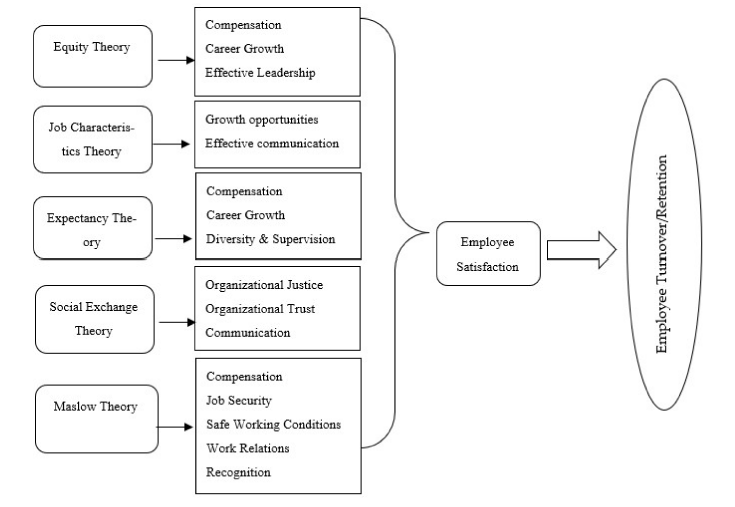
Model of Theories for Employee Retention
(Ghani, et al., 2022)
Article 1
The purpose of the study is to navigate the relevance of transition in the training system in the hospitality industry, notably when it comes to import substitution, to enhance employee retention and reduce turnover. Participants included multiple scholars from multiple academic domains, along with the active participation of tourists. Educators, employees, employers, and scientists are also included. Zaitseva et al (2016) found that there is a significant gap in training and education as far as the demand for an efficient workforce is concerned. Without training, employees cannot create competitive products according to expectations, and this leads to demotivation and turnover (Zaitseva et al., 2016). Indeed, employers in the organization need to actively engage in training and development activities to justify the importance of retention and impact on service.
Article 2
The purpose of this article is to streamline the impact and importance of in-house training programs for hospitality undergraduates. The article indirectly highlights the probability of a lack of retention in the hospitality industry due to the lack of training, skills, and knowledge. People or fresh graduates in the hospitality industry usually need to get all the training and expertise, which further impairs motivation, performance, and career paths (Fuchs, 2022). Thus, the probability of retention is high even in the goods hospitality firms when it comes to fresh employees. Almost 30 undergraduate students were included in this research to get insights. Fuchs (2022) found that in-house training can be a significant driver for employees to evade the probability of turnover and enhance performance with specific career paths (Fuchs, 2022).
Article 3
The purpose of this article has been to underline the reasons for the lack of employee retention or high turnover. Poor working conditions and the demanding climate in this fast-paced hospitality industry are some reasons. Managers in the hospitality industry are leaving the organizations due to poor career paths and inadequate skill training to integrate with customer satisfaction (Walsh & Taylor, 2007). The situation becomes hectic when current training and career paths contradict the new hospitality industry design. Management professionals, notably managers, were included in this study to provide insights into their expectations. Walsh & Taylor (2007) unveiled that retaining management talent in the hospitality industry is always important, but it can be done by creating chances for self-improvement in the internal business climate (Walsh & Taylor, 2007).
Article 4
The purpose of this article by Mohammad (2020) is to understand the importance of employability skills, which can be obtained through training and development, especially in the hospitality industry. High turnover and lack of retention are probable in the industry because many of the fresh graduates need to possess employability skills. The real hospitality business and workplace situation is quite different, and it sometimes becomes hectic and demanding for new employees. Graduates and undergraduate students participated in this research to provide insights regarding the needs of employability. Consequently, turnover and lack of retention can be avoided if employees come up with employability skills. Mohammad (2020) found that employability skills and motivation, backed by training, lead to the employer’s aspiration, and it can improve retention in many ways.

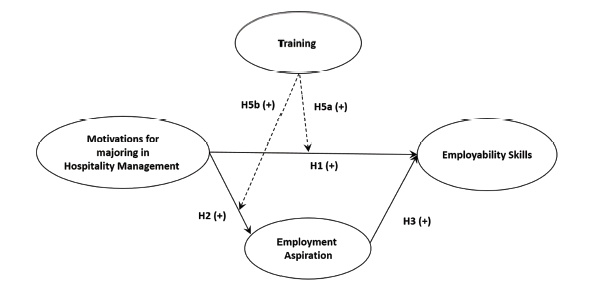
Conceptual Framework
(Mohammad, 2020)
Article 5
Ghani, et al (2022) explored the need for employee retention in the hospitality industry as far as the challenges are concerned. The study is a blend of theoretical and practical insights for the industry. All 48 research papers are included to support this literature, as the whole information stresses the impact of turnover and the possibilities of effective employee retention strategies. Ghani, et al (2022) found that the organization, with the implementation of employee retention strategies, can create a positive impact in the form of employee satisfaction and commitment. Training and development functions must be embedded with a positive work climate, career growth options, and effective communication. The finding suggested that retention is easy with effective communication and growth opportunities (Ghani, et al., 2022). It concludes that retention challenges are in the spotlight in the hospitality industry, especially in the pandemic situation. Now, meeting employee expectations in terms of growth through training is the best way to improve retention.
Article 6
Liu-Lastres et al (2023) navigated the great resignation in the contemporary hospitality industry. This great resignation or high turnover has been in the limelight due to poor training and development initiatives. New and experienced people are leaving the organization because training and development are needed to meet the expectations and new needs of the hospitality workplace. The study included professionals and people from all levels of the organization who have turnover intentions due to multiple reasons. Liu-Lastres et al (2023) unveiled that poor retention is probably due to a lack of inclusive workplace, employee-management relations, and employee-centered culture in the internal climate. Thus, in the new development programs for hospitality employees, these facets must be included (Liu-Lastres et al., 2023). It concludes that the dynamics of training and development must be changed in the modern hospitality industry as far as the new needs and expectations are concerned, and it is the only way to reduce retention.
Article 7
The purpose of Popescu & Ciorei (2023) is to navigate the multiple factors that can create an impact on employee retention. Insights and implications regarding the hospitality industry can be derived. It is a broader research study that streamlines organizational justice, leadership style, and social support as critical aspects regarding employee retention. This study included multiple employees from multiple industries, and the inclusion from the hospitality industry is quite apparent. Popescu & Ciorei (2023) streamlined the role of ethical leadership in employee retention. Missing a link to ethics in the current training and development practices has led to the turnover. Employee retention will be effective and evident if it becomes state-of-the-art by incorporating autonomy, support, and further training opportunities. Training and development must emphasize psychological capital and career development to make employees stray in the long run (Popescu & Ciorei, 2023). It concludes that the training and development functions must include advancement opportunities, precise communication, and an inclusive culture to enhance the visibility of retention.
Article 8
Kar & Phuong (2023) investigated employee turnover in hospitality organizations, especially in demanding situations like the pandemic. Employers intended to contain the branding attributes to create a negative impact on turnover intentions and enhance employee retention. The high employee turnover in the hospitality industry is evident because the current training and development practices and efforts need to incorporate social, economic, and security values. Almost 200 hospitality employees participated in this research study to understand the branding attributes of companies and their impact on turnover intentions. Kar & Phuong (2023) find that incorporating the social, economic, and security values in the training and development function can improve employee retention. Expectations of the hospitality workforce have changed in the pandemic situation, leading to excessive turnover. Thus, these facets must be part of the training and development to make employee retention a new normal (Kar & Phuong, 2023). It concludes that the role of employers and managers in employee retention is critical, as they can also be trained to demonstrate strategies or priorities to evade turnover intentions.
Article 9
The purpose of Bharwani & Butt (2012) is to assess the employee retention challenge from the perspective of the global hospitality industry. Human resources also depict a particular narrative about this challenge. In the changing business situation and new hospitality trends, employees need to be made aware of the shift in their working patterns and behaviors. More than outdated training and development is required to set the foundation for a stimulating and gratifying work environment along with proactive engagement and motivational initiatives. Hospitality practitioners in India and multiple human resource experts have participated in this study to build narratives. Bharwani & Butt (2012) find that the training and development interventions must strive for suitable employee engagement and motivation initiatives, which can help to evade the problem of employee retention. It concludes that current training and development processes without forging a shared sense of identity and purpose cannot be justified as far as the lack of retention or increased turnover is concerned (Bharwani & Butt, 2012).
Article 10
The purpose of this article by Pham & Tran (2023) is to investigate the role of organizational culture in employee retention. Poor organizational culture has become one of the main drivers of the employee retention challenge. Indeed, positive organizational culture is interrelated with the training and development functions, and outdated approaches make things unfavorable. 355 healthcare professionals have participated in navigating the influence on employee satisfaction and loyalty. The big mistake that the organizations have made is avoiding the evaluation of the training programs to assess the relationship between relationships and loyalty further. Pham & Tran (2023) found that employee training and development must strive for growth opportunities and loyalty measures to make some adjustments accordingly. It concludes that training and development are good sources for creating a positive corporate culture, and it can lead to improved retention, satisfaction, and loyalty (Pham & Tran, 2023).
Filling the Gap
The research fills the gap in the existing literature because it provides the combination of strategies or possibilities that must be incorporated into the human resource domain of hospitality firms. The research comes up with an incredible combination of retention problems, challenges, and solutions, and it makes it complete.
Recommendations
Practical Implications
There are some practical implications regarding this research. This research can be used in the real world, especially in the hospitality industry, as new narratives can be incorporated into employee retention and training approaches. These new narratives or arguments can become the base for human resources to shape or redefine their employee retention and training strategies to eliminate or reduce the problem. As a consultant to conduct this research, I want to tell organizations to evaluate and refine their retention and training approaches as far as the negative impact of existing strategies is concerned. The most important thing is to streamline the new expectations, needs, trends, and behaviors of employees in the hospitality industry and link them to training and development. It is the best way to transfer this knowledge to the hospitality business to eliminate the retention problem. Several facets, such as positive work culture, autonomy, growth opportunities, communication, and new work dynamics, must be transferred to companies to get things in their favor.
Conclusion
Potential Directions
Future research can be conducted by hitting other pertinent domains. In future research, it seems imperative to understand the causes of employee turnover despite attractive retention strategies. Examples of real-time hospitality firms will be valuable as far as the increasing turnover is concerned. Exploring or getting deeper into the current training and development practices of hospitality firms can be the new direction to gain a more precise picture of the retention problem. The research interrelates with several areas that further present some research opportunities. If the organization makes some shifts in the retention strategies and training efforts, it can create pressure in the financial domain. Thus, the link between the economic constraints of the hospitality firm and its impact on retention is a new research domain, and it should be conducted to derive more insights and implications about the retention challenge.
Limitations
The research needs to be more extensive, as it narrows the focus on the hospitality industry. Interestingly, some insights from other industries have been obtained in this research, but the focus remains on hospitality and its retention paradox. However, the study is independent of the demographics and geographics, as far as the variety of the participants and the broader hospitality industry are concerned. Still, some changes in this research process can be made. The research can narrow its focus to young hospitality employees and their turnover intentions. It can be a solid link to investigate specific demographics in the hospitality workplace to get more precise insights.
Summarizing Purpose
Eventually, the purpose of this research was to investigate the employee turnover challenge due to the current training and development efforts in the hospitality industry. The research went well, as it is full of current literature and findings to build new narratives about a challenge or problem. Transferring these findings or knowledge to businesses in the hospitality industry, especially in terms of critical retention and training strategies, is highly recommended. The paper has been rationalized through literature and further narratives, and it is still open as far as the limitations are concerned.
References
Bharwani, S., & Butt, N. (2012). Challenges for the global hospitality industry: an HR perspective. Worldwide Hospitality and Tourism Themes, 4(2), 150-162. doi:https://doi.org/10.1108/17554211211217325
Fuchs, K. (2022). An interview study to explore the perceived usefulness of in-house training programs in tourism and hospitality education. Faculty of Hospitality and Tourism, Prince of Songkla University, Thailand, 812, e12547. doi:https://doi.org/10.1016/j.heliyon.2022.e12547
Ghani, B., Zada, M., Memon, K. R., Ullah, R., Khattak, A., Han, H., . . . Araya-Castillo, L. (2022). Challenges and Strategies for Employee Retention in the Hospitality Industry: A Review. Sustainability, 14(5), 2885. doi:https://doi.org/10.3390/su14052885
Kar, A., & Phuong, T. N. (2023). Investigating the influences of employer branding attributes on turnover intentions of hospitality workforce in the COVID-19 in Vietnam. Journal of Hospitality and Tourism Insights, 6(5), 2173-2198. doi:https://doi.org/10.1108/JHTI-05-2022-0211
Liu-Lastres, B., Han, W., & Wei-Jue, H. (2023). A reflection on the Great Resignation in the hospitality and tourism industry. International Journal of Contemporary Hospitality Management, 35(1), 235-249. doi:https://doi.org/10.1108/IJCHM-05-2022-0551
Meira, J. V., Hancer, M., dos Anjos, S. J., & Eves, A. (2023). Human Resources Practices And Employee Motivation In The Hospitality Industry: A Cross-Cultural Research. Tourism and Hospitality Management, 29(2), 157-167. doi:https://doi.org/10.20867/thm.29.2.1
Mohammad, A. (2020). Understanding Motivations, Employability Skills, Employment Aspiration, and Training of Hospitality Management Undergraduates. Tourism Review International, 24(1), 185-199. doi:https://doi.org/10.3727/154427220X15971786398810
Pham, H. H., & Tran, T. T. (2023). Strengthening the Link Between Organizational Culture and Employee Loyalty: Exploring the Mediating Effects of Employee Trust and Job Satisfaction. Global Business & Finance Review, 28(3), 68-84. doi:https://doi.org/10.17549/gbfr.2023.28.3.68
Popescu, M. A., & Ciorei, M. A. (2023). State of the Art in Employee Retention. FAIMA Business & Management Journal, 11(2), 61-71. https://www.proquest.com/scholarly-journals/state-art-employee-retention/docview/2840373988/se-2?accountid=30552
Walsh, K., & Taylor, M. S. (2007). Developing in-house careers and retaining management talent. Cornell Hospitality Quarterly, 48(2), 163-182. doi:10.1177/0010880407300521
Zaitseva, N. A., Goncharova, I. V., & Androsenko, M. E. (2016). Necessity of Changes in the System of Hospitality Industry and Tourism Training in Terms of Import Substitution. International Journal of Economics and Financial Issues, 6(1), 288-293.